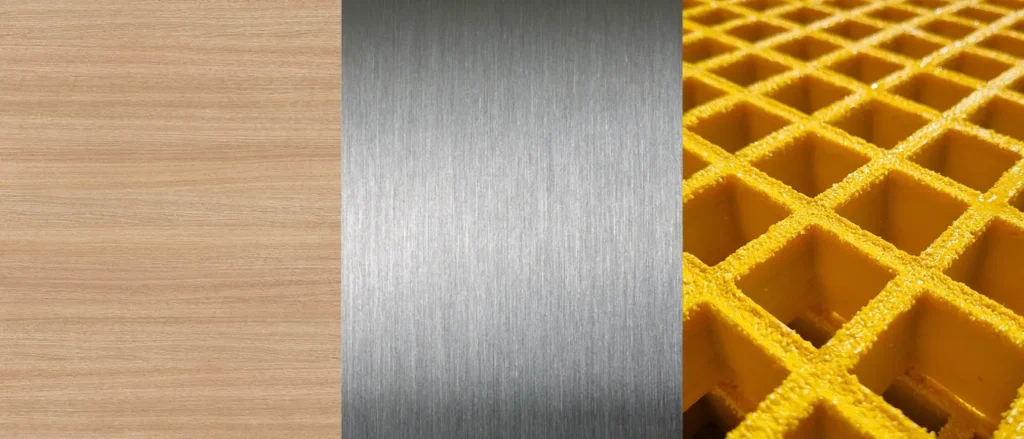
When planning a building project, it’s essential to choose the right building materials. The materials you choose affect the integrity, durability, ease of use, cost, and longevity of your build. Many builders have extensive experience working with traditional materials such as timber and steel, but with the introduction of innovative composite materials such as Fibre Reinforced Polymer (FRP), we must consider whether traditional is still the best.
In this article, we will explore the different properties, benefits and drawbacks of traditional building materials and modern composite solutions to help you make informed decisions for your future projects.
Timber
Timber has been a primary building material since the dawn of civilisation and has evolved significantly. Stemming from simple, untreated roundwood to the complex, treated timber structures we have today, timber remains one of the most popular building materials.
Whether building decks, structures, or decorative features, timber is a visually appealing, safe, and easy-to-use material. However, it’s also important to consider the drawbacks and maintenance required to keep it strong and appealing.
Strengths
Natural Aesthetics
Timber offers a unique textural and natural visual appeal for architectural designs.
Customisable & Easy to Install
Timber is easy to cut to size to meet project requirements and install in most applications.
Safe & Non-Conductive
Timber is a non-conductive material, making it a safe choice, especially for electrical environments.
Weaknesses
Deteriorates
Timber can rot, swell, or warp when constantly exposed to moisture, humidity, or chemicals, reducing the structural integrity.
High Maintenance
Timber requires extensive maintenance to ensure durability and aesthetics, such as treating for pests, painting or oiling, and cleaning.
Susceptible to Pests
Termites and other pests can damage timber.
Steel
Steel has long been celebrated as the backbone of modern construction. Offering exceptional strength and reliability to support versatile designs, steel is ideally suited for buildings, bridges, and industrial facilities. Despite its many advantages, steel also has a few drawbacks and maintenance requirements to consider.
Strengths
Highly Durable
Steel is long-lasting, durable and strong, capable of supporting complex and large-scale structures.
Pest Resistant
Steel is not impacted by pests, including termites, reducing long-term damage risks.
Prefabricated
Steel can be manufactured to meet project requirements, supporting tailored projects and smooth installation.
Recyclable
Steel has a high recycling rate, making it an environmentally friendly choice.
Weaknesses
Corrosive
Steel is susceptible to rust and corrosion when exposed to moisture, humidity, and chemicals.
Heavy
Steel is heavy, which can increase transportation and handling costs.
Conductive
Steel is highly conductive, presenting potential risks in electrical and industrial environments.
High Maintenance
Steel requires regular cleaning, repainting and corrosion treatments to maintain integrity.
Fibre Reinforced Polymer
Fibre Reinforced Polymer (FRP) stands out as a revolutionary game-changer for construction projects. Combining high-performance fibres with a strong polymer matrix, FRP is a high-strength alternative to traditional materials.
This innovative composite solution is designed to offer all the benefits of conventional materials, while also standing strong against corrosion with little to no maintenance, even in harsh environments. FRP embodies the future of construction, with strengths that far outweigh the weaknesses.
Strengths
Strong & Durable
FRP is resistant to rust, corrosion, UV, and pest damage, even when exposed to harsh conditions such as water submersion or chemicals.
Safe & Non-conductive
Featuring a non-conductive and slip-resistant design, FRP is a safe choice for industrial, commercial, and residential settings.
Low Maintenance
FRP is maintenance-free, standing strong with no cleaning or treatments required.
Easy to Install
FRP is easy to cut and install with basic tools, enabling fast, smooth customisation and installation.
Cost Savings
While FRP can be more expensive than certain traditional materials upfront, it offers significant long-term savings by reducing freight, installation, and maintenance requirements and costs.
Weaknesses
Higher Initial Cost
Some FRP products can carry a higher upfront cost than certain traditional materials, such as timber, which can impact project budgets initially. However, it offers superior durability and cost-efficiency long-term.
Overall Comparison: FRP vs Timber vs Steel
Property | FRP | Timber | Steel |
|---|---|---|---|
 |  |  | |
Resistance to Rust / Corrosion | Will not rust or corrode, even with constant water exposure | Rots, swells, and warps when exposed to moisture | Rusts and requires ongoing painting or corrosion treatments |
Weight | Up to 70% lighter than steel; easy to transport and install | Moderate | Heavy, greater structural load |
Electrical Conductivity | Non-conductive | Non-conductive | Conductive |
Maintenance Needs | Low | High | High |
Workability / Installation | Easy to cut and install with basic tools; simple repairs | Easy to cut and install | Requires special tools for cutting/installation |
Resistance to Chemicals / Moisture | Excellent | Prone to rot/swelling | Can corrode due to chemicals |
Pest Resistance | Immune to termites and pests | Susceptible to termites and other pests | Not affected by pests |
Durability in Outdoor / Wet Environments | Highly durable and long-lasting | Deteriorates quickly in moist or humid conditions | Durable but maintenance intensive |
Connection Methods | Mechanical Fixings & Adhesive Bonding | Timber Joinery & Mechanical Fixings | Welding & Mechanical Fixings |
Selecting the Right Material for Your Project
Selecting the right material for your project is essential for ensuring long-term safety, durability, and reliability. Traditional materials are traditional for a reason, this is often because they are reliable, but that doesn’t mean they are always the best solution. It’s important to consider your project’s specific requirements and the advantages and drawbacks of every material before making a decision.
When making your decision, consider the following factors:
- Environmental Conditions
- Structural Requirements
- Budget
- Aesthetics
- Installation
- Maintenance
Ultimately, by understanding the strengths and limitations of each material, you can make more informed decisions for future projects and ensure your builds are strong, durable, reliable, and safe long-term.
Build Smarter, Stronger, and Longer with FRP Solutions
Considering making the switch to innovative FRP solutions for your next construction? Our expert team at GRP is here to guide you with tailored advice, ensuring you choose innovative FRP solutions for a durable and reliable build. Contact us today and take the first step toward smarter construction!